A leading HVAC supplier can provide pleasant conditions for the entire ship. Koja Marine air conditioning systems improve energy efficiency and passenger comfort. You can trust our HVAC system design, production and commissioning throughout the ships life cycle. We control all conditions on board.
Property sustainability and productivity rise with the same tide. Wave Solution reduces the amount of purchased energy by up to 70% and ensures the well-being of property users.
Koja has delivered reliable and efficient fan solutions since 1935. Our reliable process fans are also energy- efficient – even in demanding processes. Nearly 50,000 fans have been delivered all over the world.
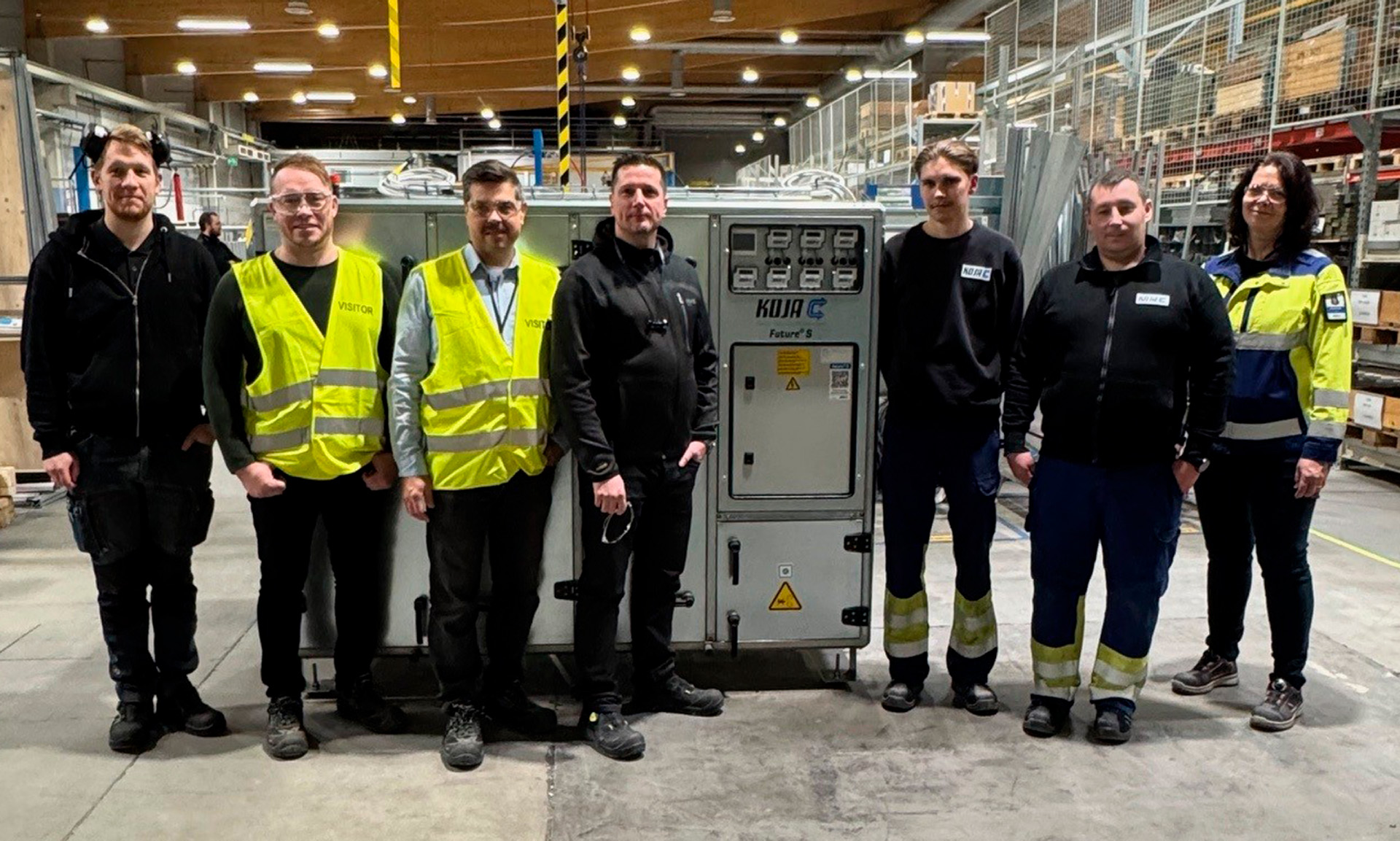
Photo: At the handover event for the Koja Future S air handling unit at Koja’s Jalasjärvi factory. From left: Foreman Jarno Kantti, Koja Oy; Head of Education Jani Pusa, Sedu; Education Coordinator Jani Saarimaa, Sedu; Foreman Tuomo Juupaluoma, Koja Oy; Electrician Toni Ketola, Koja Oy; Electrician Jarno Uusi‑Penttilä, Koja Oy; and HR Manager Päivi Laaksoharju, Koja Oy.
CONCRETE COLLABORATION BETWEEN KOJA AND SEDU – AN AIR HANDLING UNIT FOR ELECTRICAL ENGINEERING EDUCATION
Koja and Sedu have had multidimensional cooperation for a long time. Koja regularly hosts students for on‑the‑job learning from fields such as electrical and automation engineering, robotics, building services engineering, mechanical and production engineering, logistics, and property maintenance. The collaboration covers different levels of qualifications, and mutual visits and knowledge-sharing take place regularly. This ensures both the competence and availability of future workforce and allows the two organizations to jointly develop education to better meet the needs of working life.
The latest – and very concrete – form of cooperation focuses on developing learning environments: Koja has donated a Future® S air handling unit to Sedu’s Electrical Engineering Program for educational use.
“This is extremely important for us and a fantastic opportunity,” says Jani Pusa, Head of Education at Sedu Törnäväntie.
“Two thirds of each annual cohort in electrical engineering complete the building automation module. It’s a substantial part – 45 competence points. There’s a lot to master in modern building automation.”
“This unit is similar to the ones we mainly deliver to renovation sites,” explains Koja’s foreman, Tuomo Juupaluoma. “Nowadays, buildings typically use several smaller air handling units distributed around the facility instead of one or two large ones. This improves energy efficiency and enables better control and optimization of the indoor climate. This unit includes all the same functions as the large ones.”
“With this equipment, electrical engineering students can practice understanding P&I diagrams, pressure sensing, and using the control system. It’s an excellent contribution from Koja – corporate cooperation at its best. Our learning environments will improve even further thanks to this,” adds Jani Saarimaa, Education Coordinator at Sedu Törnäväntie.
“We are happy that our air handling unit can be utilized in Sedu’s learning environment,” says Päivi Laaksoharju, HR Manager at Koja’s Jalasjärvi factory.
Hands-on training strengthens building automation skills
Education Coordinator Jani Saarimaa demonstrates the versatile teaching possibilities of the air handling unit in the electrical engineering facilities at Sedu Törnäväntie.
“We will adapt the unit for educational use by integrating a fault simulator,” Saarimaa says. “The device will operate normally, but with the simulator we can introduce sensor faults during operation. First, students analyze the fault message, then locate the issue using the P&I diagram, and finally examine it on the actual device.”
“This provides excellent opportunities to practice P&I diagrams and gain a general understanding of what an air handling unit is and what its purpose is,” Juupaluoma confirms.
“And students also get to see concretely what part electrical work plays in our installations,” adds Laaksoharju.
“Previously, electrical engineering has not had a learning environment related to HVAC technology of this type. Electrical installation students focus on understanding the operating principles of the equipment and the aspects most relevant to the work of an electrician,” Saarimaa explains.
“Both students and teachers are excited about this. The unit is practical, stand‑alone, and dedicated entirely to educational use, with a wide range of sensors and actuators. As a separate unit, it can be safely disassembled, assembled, and shut down for practice.”
“This addition supports the competence requirements of the building automation module and improves students’ readiness for working life in the field of building automation,” Saarimaa concludes.